sat suite question viewer
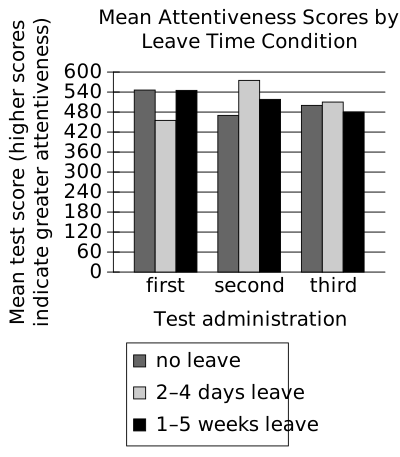
- For each data category, the following bars are shown:
- no leave
- 2–4 days leave
- 1–5 weeks leave
- The data for the 3 categories are as follows:
- First test administration:
- no leave: 546
- 2–4 days leave: 455
- 1–5 weeks leave: 545
- Second test administration:
- no leave: 470
- 2–4 days leave: 575
- 1–5 weeks leave: 518
- Third test administration:
- no leave: 500
- 2–4 days leave: 510
- 1–5 weeks leave: 480
- First test administration:
To investigate potential cognitive benefits of taking leave from work, psychologist Jan Packer and colleagues conducted a six-month study of Australian university staff members who took no leave from work during the study, took 2–4 days of leave, or took 1–5 weeks of leave. Tests of attentiveness were administered to participants three times during the study: at random for the no-leave staff, and for the rest, one week before their leave, one week following their return to work, and one week after the second test administration. After analyzing the results, the researchers concluded that longer leave times might not confer a greater cognitive benefit than shorter leave times do.
Which choice best describes data from the graph that support the researchers’ conclusion?
Explanation
Choice C is the best answer because it describes data from the graph that support Jan Packer and colleagues’ conclusion about the effect of leave time on the attentiveness of university employees. According to the text, the researchers’ study design included a group of employees who took no leave, a group who took 2–4 days of leave, and a group who took 1–5 weeks of leave. The participants who took leave were tested for attentiveness one week before their leave (the first test administration), one week after their return to work (the second test administration), and two weeks after their return (the third test administration). The participants who took no leave were tested three times at random. The graph shows that at one week after their return to work, participants who took only 2–4 days of leave had an average attentiveness score of between 540 and 600, while participants who took 1–5 weeks of leave had an average score of between 480 and 540. At two weeks after their return to work, those who took only 2–4 days of leave had an average score of between 480 and 540, while those who took 1–5 weeks of leave had an average score of approximately 480. In other words, the graph shows that on both post-leave testing dates, participants with longer leave times had lower average attentiveness scores than those with shorter leave times. Since attentiveness is an indicator of cognitive functioning, these data confirm Packer and colleagues’ conclusion that longer leave times might not confer a greater cognitive benefit than shorter leave times do.
Choice A is incorrect. The graph does show that in the second test administration, participants who took 2–4 days of leave had higher average attentiveness scores than did those who took no leave and also shows that in the third test administration, those who took no leave had higher average scores than those who took 1–5 weeks of leave. But neither of these findings has a direct bearing on the researchers’ conclusion, which concerns a comparison of participants who took 2–4 days of leave with those who took 1–5 weeks, rather than a comparison of either group with participants who took no leave. Choice B is incorrect. Although the graph does show that in the first test administration, participants who took 2–4 days of leave had lower average attentiveness scores than did those who took 1–5 weeks of leave and those who took no leave, this test administration occurred before any participants went on leave; therefore, these results have no bearing on the researchers’ conclusion about how the amount of leave taken by participants affected their cognitive functioning. Choice D is incorrect. Although the graph does show that in the second and third test administrations, participants who took 2–4 days of leave had higher average attentiveness scores than did those who took no leave, the researchers’ conclusion is about the effects of short leave compared with the effects of long leave, not the effects of short leave compared with the effects of no leave. These results are therefore irrelevant to the conclusion.